Patient Story of Living with Retinitis Pigmentosa
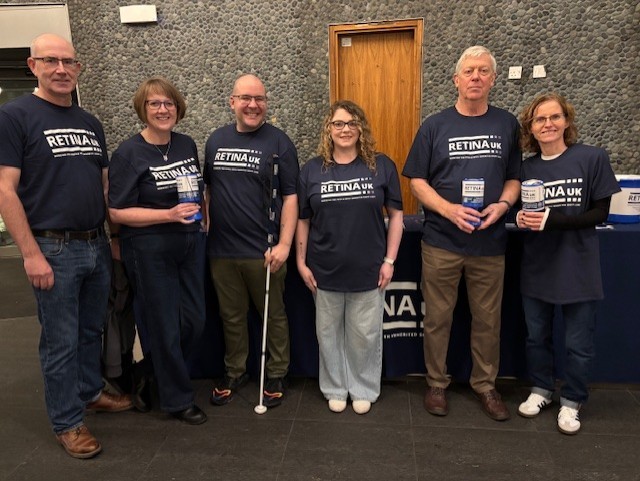
Our trustee, Fiona Copeland, recently met Adrian at a fundraising event for Retina UK. He shared with her his Retinitis Pigmentosa (RP) diagnosis and how it affects him every day. He is keen to share his story to help raise awareness of RP and to help demonstrate why it is so important that we continue to advocate for research into this condition. If you would like to share your story then please contact us.
The Long Road After Diagnosis
By Adrian Madzura
After being diagnosed with retinitis pigmentosa, a degenerative eye condition, one man’s life was turned upside down. Independence and certainty disappeared almost overnight. What followed was a difficult journey through fear and financial hardship but also the discovery of art, support and a new sense of purpose.
“It takes time to accept the situation you’re in… And to learn to love yourself all over again.”
Before his diagnosis, Adrian Paternoster’s life followed a familiar rhythm. He worked full-time, travelled to work each day and built a steady life with his wife, Louise. The couple had moved from High Wycombe to Aylesbury, settling into what felt like a normal routine. Work was physical and demanding, but it was also stable.
Then small things began to go wrong.
At first it was difficult to explain. Cycling to work became unpredictable. Objects appeared where he did not expect them to be. Lamp posts and kerbs crept into his path. “I was bumping into things more,” he recalls. “When I was riding my bike to work, I would come off the footpath into the road or go into lamp posts.”
Something clearly was not right. At first, the fear was that it might be something even more serious. “We were thinking the worst before it was like a brain tumour or something.”
Tests began in 2022. One involved an uncomfortable procedure measuring the electrical response of the eye. But then something strange happened. The results disappeared.
The hospital had lost them.
Believing that silence might mean everything was fine, he carried on. It was only a year later, shortly before Christmas in 2023, that he decided to ask what had happened. The answer set everything in motion.
“They said we haven’t got anything on the screen re your results.”
Within hours a doctor called him back. He was asked to return immediately for further tests. When the results came through, the diagnosis was confirmed.
Retinitis pigmentosa, often shortened to RP.
The condition causes progressive loss of vision as cells in the retina slowly stop functioning. There is no cure, and progression varies from person to person.
He remembers the moment vividly.
“They sort of sat me down and said we suspect you have RP,” he says. “They registered me severely sight impaired on the spot.”
The impact was immediate and disorientating. “My mind was scrambled.”
At first, the future felt uncertain in ways he had never experienced before. “Getting told you have a condition that deteriorates over time… they don’t really know the progression speed. That’s the fear in the back of my mind.”
Like many people facing sudden disability, he tried to continue as normal. At the time he was working two jobs. One involved caring for elderly residents. The other was physically demanding factory work producing windows and doors.
His employers were supportive. Adjustments were made where possible.
“They were fantastic at the factory,” he says. “They put everything in place to keep me safe and keep me there.”
But eventually the practical difficulties became impossible to ignore. Tools began to disappear. Tasks that once felt routine became dangerous.
“I couldn’t keep up with the pace of the work. I was losing my tools. Everything was getting more difficult.”
Leaving work was one of the hardest decisions he has had to make.
“The biggest decision I ever made was to keep myself safe and keep other people safe,” he says quietly.
He asked the company director for a medical dismissal letter.
“She said it was the hardest letter she had ever written in her career.”
Without work, life changed quickly. The routine and sense of purpose that had structured his days disappeared almost overnight.
“It was a really difficult transition from work to being at home.”
The only guidance he received from the hospital was a leaflet. He believes it came from the RNIB[O1] . Beyond that, he and Louise had to work things out themselves.
The practical challenges arrived quickly. Rent still needed to be paid, but he was no longer earning. For the first time in his life, he had to navigate the benefits system.
“I’ve never been on benefits before,” he says. “I felt a little bit lost.”
The paperwork was overwhelming. Forms demanded every detail of his condition and circumstances. He tried to find help wherever he could.
“I remember saying to Citizens Advice and lots of places, can someone please come over and just sit down with me and help me go through the forms.”
Eventually support came through, but only after a long wait.
“After about a year and a half I got the benefits needed to help keep the roof above us.”
During that period money was tight. At times the couple relied on food banks. The stress took its toll.
“My mental health wasn’t great at the time,” he says.
Even basic things like moving around the building where they lived became difficult. Their rented flat was on the third floor, and the stairs posed a daily challenge.
He remembers falling once on the staircase.
At first, he tried to brush it off, but Louise recognised the danger.
“She pushed for a council place on the ground floor to keep me safe.”
Eventually they were able to move into a more suitable home. Slowly, stability began to return.
Looking back now, he describes the whole period simply as “a roller coaster of emotions”.
Through it all, Louise remained constant. “She was there every single step.”
Support eventually came from other places too. Searching online for informat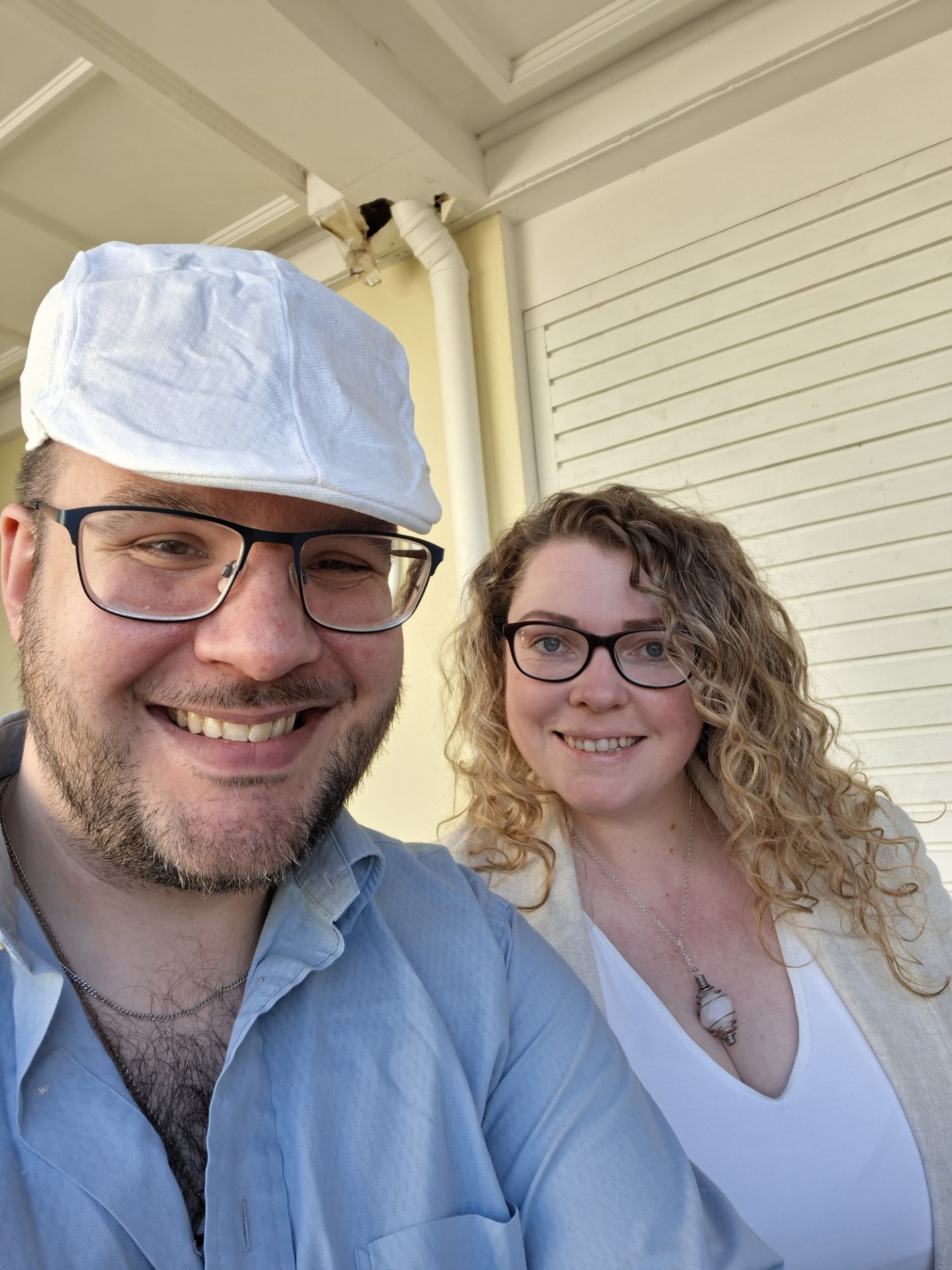 ion about RP led him to Retina UK, a charity supporting people with inherited sight loss.
Watching one of the organisation’s conferences online proved unexpectedly powerful.
“It gave me a little bit of a flame to push forward and focus on something.”
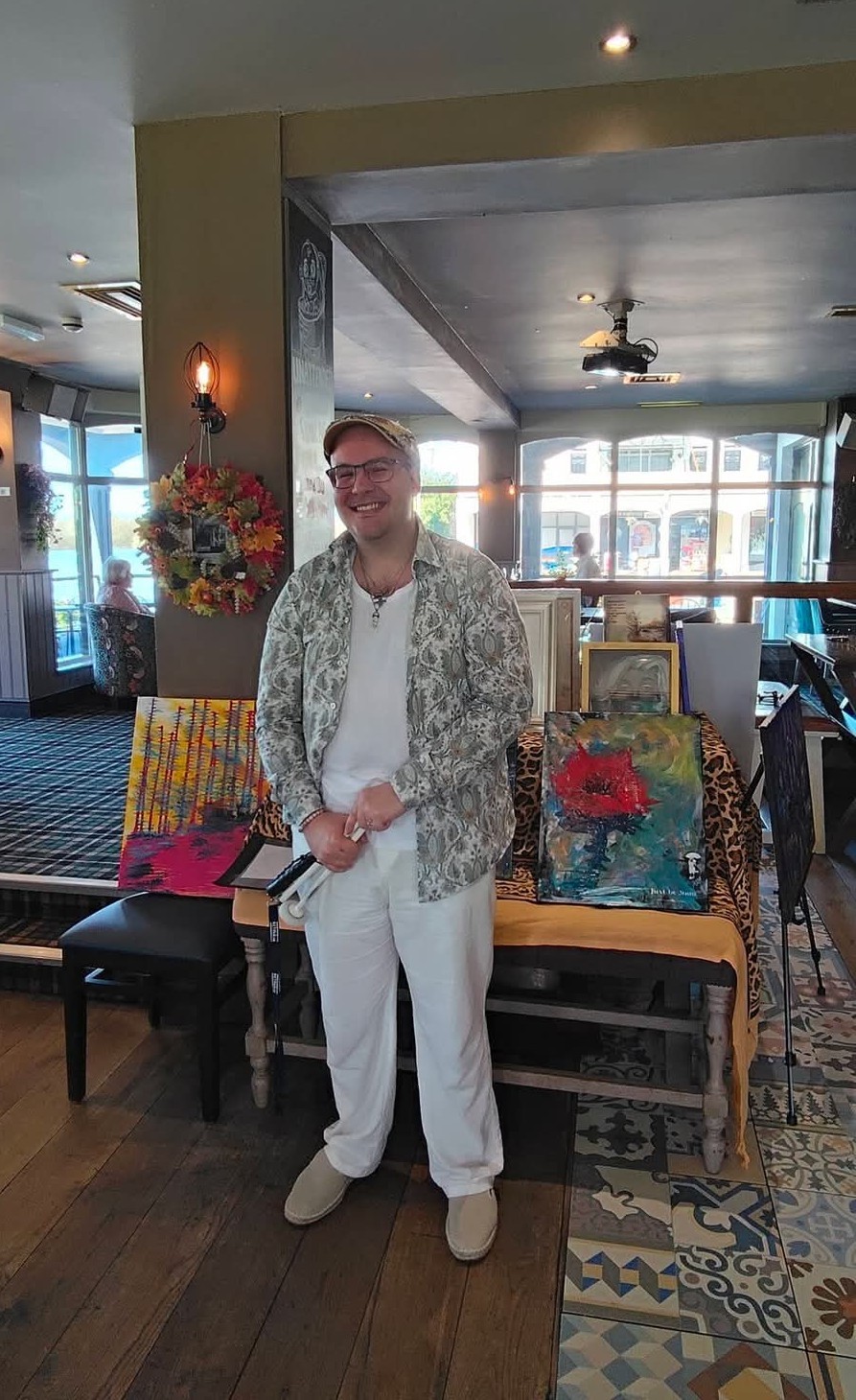
That focus became art.
Painting provided something he had not realised he needed. It offered a way to process what had happened, while also creating something positive from it.
“Finding therapy for myself with art really helped me get through day by day.”
He began donating money raised from his artwork to Retina UK. One of his designs was later chosen for the charity’s Christmas cards. He was invited to speak about his work on television, appearing on both ITV and the BBC.
“It was really humbling,” he says. “And it gave my confidence and mental health a real boost.”
Just as important was the human support he found through the charity. Every Friday he speaks with a staff member named Joe.
“It’s just a chat every Friday,” he says. “But it’s a real support.”
He believes those conversations came at a critical moment.
“Without that chat support I probably wouldn’t be here,” he says. “They put safeguarding in place for me and helped me get the help I needed.”
He is now fundraising for the charity and recently completed a sponsored walk.
Daily life today is quieter than it once was. Mobility training has helped him learn routes using a cane. He now travels independently to a nearby bus stop and to a local coffee shop where a mental health group meets each week.
The routine may appear modest from the outside, but for him it represents something significant: rebuilding independence.
He keeps an eye on developments in RP research. Genetic testing revealed that his mutation is rare, which means progress may take longer.
“There’s not hardly any research into this gene,” he says.
For now, doctors are monitoring the progression of the disease. A research group in Switzerland has begun looking at the gene involved. If trials become possible in the future, he may be contacted.
The possibility offers cautious hope, but it also raises difficult questions.
“I really want to stop the progression,” he says. “But the vision I have, I hold onto it dearly. I really value what I still have.”
What makes the biggest difference is support. Friends, family and communities that understand what people are going through.
That tension between hope and caution is something many people living with degenerative conditions understand well.
If he could offer advice to someone newly diagnosed, it would not be about medical treatments or future breakthroughs.
It would be about time.
“It takes time to accept the situation you’re in,” he says. “And to learn to love yourself all over again.”
The emotional impact of sight loss, he believes, is often underestimated.
“I strongly push that the mental health of individuals is so important.”
“I think being surrounded by people who support you is a massive part of the journey.”
Without that support, he says, it is easy to withdraw into yourself.
With it, even a life reshaped by illness can begin to find new meaning.